Stop Panicking About Your Morning Glucose: Dawn Phenomenon vs Cortisol Awakening Response
Introduction
You wake up.
You have not eaten in several hours.
Your continuous glucose monitor (CGM) reads 102–110 mg/dL – maybe higher.
Confusion sets in.
“How can my blood sugar be elevated if I didn’t eat anything?”
Morning glucose elevations are one of the most misunderstood metabolic patterns among individuals with insulin resistance, prediabetes, and type 2 diabetes. Two physiological processes are commonly blamed: the dawn phenomenon and the cortisol awakening response (CAR). Although they are related to circadian hormone rhythms, they are not the same process—and misunderstanding the difference can lead to unnecessary anxiety and inappropriate interventions.
This article clarifies the mechanisms, differences, and clinical implications of both processes so you can interpret your morning glucose with physiological context rather than fear.
The Dawn Phenomenon: A Pre-Waking Hormonal Surge
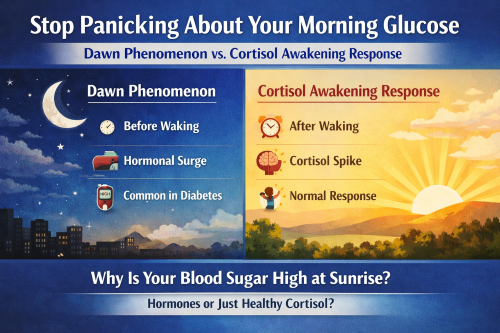
The dawn phenomenon (DP) refers to an early-morning rise in blood glucose occurring typically between 3:00 a.m. and 8:00 a.m., before awakening (Monnier et al., 2013). It is driven by the circadian release of counterregulatory hormones, including:
- Growth hormone
- Cortisol
- Glucagon
- Catecholamines
These hormones stimulate hepatic glucose production through gluconeogenesis and glycogenolysis while temporarily reducing insulin sensitivity (Carroll & Schade, 2005).
In individuals with intact insulin function, this transient glucose rise is quickly buffered. However, in those with insulin resistance or impaired β-cell function, the liver’s glucose output exceeds the body’s capacity to regulate it, leading to measurable fasting hyperglycemia (Monnier et al., 2013).
Key Characteristics of Dawn Phenomenon
- Occurs before waking
- Seen on overnight CGM data
- More pronounced in type 1 and type 2 diabetes
- Reflects impaired glucose regulation rather than food intake
Studies suggest the dawn phenomenon contributes significantly to elevated A1C in individuals with diabetes (Monnier et al., 2013).
The Cortisol Awakening Response: A Normal Neurological Event
The cortisol awakening response (CAR) is a rapid increase in cortisol secretion occurring within 30–45 minutes after waking (Clow et al., 2010). It is not pathological. It is a healthy activation of the hypothalamic–pituitary–adrenal (HPA) axis that prepares the body for daytime activity.
Cortisol increases:
- Alertness
- Blood pressure
- Heart rate
- Hepatic glucose output
This transient rise in glucose is part of the body’s normal metabolic mobilization strategy (Pruessner et al., 1997).
Unlike the dawn phenomenon, CAR is triggered by the act of waking itself. It is influenced by:
- Light exposure
- Anticipatory stress
- Sleep quality
- Circadian alignment
In metabolically healthy individuals, this glucose rise is modest and short-lived.
Key Characteristics of Cortisol Awakening Response
- Occurs after waking
- Peaks within 30–45 minutes
- Normal physiological process
- Not inherently a sign of diabetes
Dawn Phenomenon vs. Cortisol Awakening Response: The Critical Differences
| Feature | Dawn Phenomenon | Cortisol Awakening Response |
|---|---|---|
| Timing | Before waking | After waking |
| Trigger | Circadian hormone rhythm | Awakening stimulus |
| Main Hormonal Driver | Growth hormone + cortisol + glucagon | Cortisol surge |
| Seen on CGM | Overnight rise | Rise after alarm |
| Clinical Significance | Exaggerated in diabetes | Normal physiological activation |
While cortisol plays a role in both processes, the timing and clinical implications differ.
Why Low-Carb and Carnivore Individuals May See Higher Morning Glucose
Individuals following ketogenic or carnivore dietary patterns often report slightly higher fasting glucose values despite improved metabolic markers. This phenomenon may reflect physiological insulin resistance or glucose sparing, a metabolic adaptation in which peripheral tissues preferentially utilize fatty acids while preserving glucose for obligate glucose-dependent tissues (Volek et al., 2016).
During low-carbohydrate adaptation:
- Hepatic glucose output may increase
- Fasting insulin levels typically decrease
- Ketone production rises
- Morning glucose may sit slightly higher without pathological meaning
Importantly, fasting glucose alone is a limited marker. Interpreting morning readings without considering fasting insulin, triglyceride-to-HDL ratio, A1C, and overall metabolic context can lead to misinterpretation.
When Should You Be Concerned?
Morning glucose may warrant further investigation if:
- Fasting glucose remains persistently elevated throughout the day
- A1C continues to rise
- Fasting insulin and C-peptide are elevated
- Hyperglycemic symptoms are present
However, a transient morning rise that resolves within hours, especially in the absence of symptoms and with otherwise strong metabolic markers, is often normal physiology rather than disease progression.
Practical Strategies for Managing Exaggerated Morning Glucose
If dawn phenomenon is suspected:
- Improve insulin sensitivity through resistance training
- Avoid late-night carbohydrate intake
- Consider earlier evening meals
- Prioritize sleep consistency
If cortisol awakening response appears exaggerated:
- Obtain morning sunlight within 30 minutes of waking
- Delay caffeine intake for 60–90 minutes
- Incorporate gentle movement (e.g., walking)
- Practice nervous system regulation strategies
Understanding the mechanism allows intervention to be precise rather than reactive.
Conclusion
Morning glucose elevations are not always a sign of metabolic failure. The dawn phenomenon reflects circadian hormone-driven hepatic glucose production, while the cortisol awakening response represents normal neurological activation upon waking.
Context matters.
Rather than panicking at a single fasting number, assess:
- Timing of the rise
- Broader metabolic markers
- Insulin dynamics
- Symptoms
- Dietary pattern
Physiology is complex. Data without interpretation leads to unnecessary fear. Education restores clarity.
References
Carroll, M. F., & Schade, D. S. (2005). The dawn phenomenon revisited: Implications for diabetes therapy. Endocrine Practice, 11(1), 55–64. https://doi.org/10.4158/EP.11.1.55
Clow, A., Hucklebridge, F., Stalder, T., Evans, P., & Thorn, L. (2010). The cortisol awakening response: More than a measure of HPA axis function. Neuroscience & Biobehavioral Reviews, 35(1), 97–103. https://doi.org/10.1016/j.neubiorev.2009.12.011
Monnier, L., Colette, C., & Dejager, S. (2013). Magnitude of the dawn phenomenon and its impact on the overall glucose exposure in type 2 diabetes: Is this of concern? Diabetes Care, 36(12), 4057–4062. https://doi.org/10.2337/dc13-1068
Pruessner, J. C., Wolf, O. T., Hellhammer, D. H., Buske-Kirschbaum, A., von Auer, K., Jobst, S., Kaspers, F., & Kirschbaum, C. (1997). Free cortisol levels after awakening: A reliable biological marker for the assessment of adrenocortical activity. Life Sciences, 61(26), 2539–2549. https://doi.org/10.1016/S0024-3205(97)01008-4
Volek, J. S., Phinney, S. D., Forsythe, C. E., Quann, E. E., Wood, R. J., Puglisi, M. J., … Feinman, R. D. (2016). Carbohydrate restriction has a more favorable impact on the metabolic syndrome than a low fat diet. Lipids, 44(4), 297–309. https://doi.org/10.1007/s11745-008-3274-2