Why Your Blood Sugar Feels Out of Control (Even When You’re Trying)
If you’re actively trying to improve your health, cutting back on sugar, reducing processed foods, paying attention to your carbohydrates, maybe even experimenting with fasting, it can be incredibly discouraging when your blood sugar still feels unpredictable.
You might see a spike after a meal you thought was “safe.”
You might wake up with higher fasting numbers than expected.
You might even experience crashes that leave you shaky, irritable, or exhausted.
It’s easy in those moments to assume you’ve failed or that your body is somehow working against you.
But in most cases, what feels like chaos is simply physiology that hasn’t yet been given consistent structure.
Let’s unpack what’s actually happening.
Blood Sugar Is a Hormonal Issue, Not a Willpower Issue
Blood glucose regulation is controlled primarily by hormones – most notably insulin.
When you eat carbohydrates, they break down into glucose and enter your bloodstream. In response, your pancreas releases insulin. Insulin acts like a signaling hormone, telling your cells to open up and allow glucose inside, where it can be used for energy.
In a metabolically healthy person, this system works efficiently. Blood sugar rises slightly, insulin responds appropriately, and glucose is cleared from the bloodstream in a predictable way.
However, with insulin resistance, which underlies most cases of prediabetes and Type 2 diabetes, the cells no longer respond properly to insulin’s signal. (DeFronzo, 2009; Petersen & Shulman, 2018). The pancreas compensates by producing more insulin to force the job to get done.
Over time, this compensation becomes strained.
The results can include:
- Elevated fasting glucose
- Larger post-meal spikes
- Delayed glucose clearance
- Increased fat storage
- Greater inflammation
And here is what many people are never told:
Even when you begin making healthier choices, insulin sensitivity does not instantly restore itself. Metabolic repair takes time, consistency, and rhythm.
Why Blood Sugar Spikes Still Happen on “Good” Days
Many people assume that if they avoid obvious sugar, their glucose should behave perfectly. But blood sugar is influenced by far more than just food.
1. Stress and Cortisol
When you’re under stress – whether emotional, physical, or from lack of sleep – your body releases cortisol. Cortisol signals your liver to release stored glucose into the bloodstream. (Plat et. Al., 1996). This is a survival mechanism designed to prepare you for action.
The body does not distinguish between a true emergency and chronic life stress.
Poor sleep, overtraining, under-eating, emotional strain, and even excessive fasting can elevate cortisol and raise blood sugar independent of food intake.
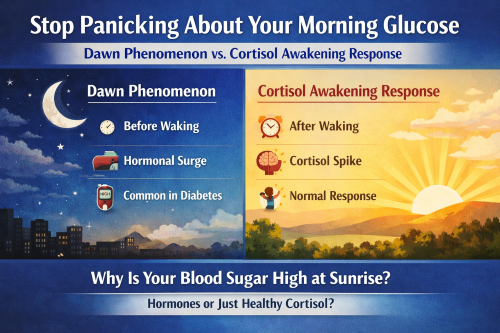
2. The Dawn Phenomenon
Many people experience higher glucose readings in the early morning. This is known as the dawn phenomenon.
During the early hours of the morning, hormones like cortisol, growth hormone, and glucagon naturally rise to help wake you up. (Schmidt et al., 1981). These hormones prompt the liver to release glucose, so you have energy to start the day.
This is not failure.
It is biology.
3. Reactive Hypoglycemia
Large carbohydrate loads, especially when eaten without protein or fat, can cause a sharp spike in glucose followed by an exaggerated insulin response. When insulin overshoots, blood sugar may drop quickly, creating that shaky, anxious “crash” feeling.
This cycle can make it feel like blood sugar is wildly unstable when in reality it’s responding to rapid input changes.
4. Inconsistent Structure
Random fasting.
Random meal timing.
Inconsistent protein intake.
Frequent snacking.
While each of these may seem harmless in isolation, together they create metabolic unpredictability. The human body thrives on rhythm. Without it, blood sugar patterns often reflect that inconsistency.
The Real Issue: Lack of Predictable Metabolic Rhythm
Most people are given advice that centers on restriction:
“Eat less.”
“Cut carbs.”
“Just exercise more.”
“Take the medication.”
But sustainable metabolic improvement is less about restriction and more about structured consistency.
When your meals, protein intake, sleep patterns, stress management, and activity levels are unpredictable, your glucose response will often mirror that unpredictability.
Structure creates stability.
And stability is what allows insulin sensitivity to gradually improve.
The Faithfully Fit Metabolic Strategy
Instead of approaching blood sugar management with panic or extremes, I encourage clients to implement foundational structure first.
Here’s where that begins:
Stabilize Protein Intake
Consistent, adequate protein at each meal helps regulate appetite, support muscle mass, and moderate post-meal glucose responses. Protein slows gastric emptying and reduces the likelihood of sharp spikes.
Establish Predictable Meal Timing
Your metabolism responds favorably to routine. Whether you choose two meals per day or three, consistency matters more than perfection.
Control Carbohydrate Load Intentionally
If carbohydrates are included, they should be paired with protein and fat. Avoid consuming carbohydrates alone, particularly refined starches or sugars.
Incorporate Post-Meal Movement
A simple 10-minute walk after eating significantly improves glucose disposal by helping muscles absorb circulating glucose. (DiPietro et al., 2013).
Protect Sleep
Sleep deprivation alone can raise fasting glucose and reduce insulin sensitivity. (Spiegel et al., 1999). Improving sleep is often one of the most underutilized metabolic interventions.
These steps are not flashy.
But they are powerful.
A Faith Perspective on Metabolic Healing
When blood sugar feels erratic, it’s easy to spiral into fear:
“What if this never improves?”
“What if I’ve damaged my body permanently?”
But fear does not improve physiology.
Scripture reminds us:
“For God has not given us a spirit of fear, but of power, love, and a sound mind.” (2 Timothy 1:7)
Metabolic healing is rarely immediate. It is built through daily stewardship – small, consistent decisions made over time.
Your responsibility is to control what you can:
- The quality of your food
- The structure of your day
- The care of your body
The outcome is not forced through panic or perfection.
It unfolds through faithful consistency.
Where to Begin Today
If your blood sugar feels out of control, resist the urge to overhaul everything at once.
Choose one stabilizing action:
- Add protein to your first meal.
- Stop grazing between meals.
- Walk after dinner.
- Go to bed 30 minutes earlier.
Consistency in one area often creates momentum in others.
Metabolic calm is not created through extremes.
It is created through rhythm.
And rhythm, over time, restores stability.
While individual responses vary, the physiological principles described here are well established in metabolic research.
References
DeFronzo, R. A. (2009). From the triumvirate to the ominous octet: A new paradigm for the treatment of type 2 diabetes mellitus. Diabetes, 58(4), 773–795. https://doi.org/10.2337/db09-9028
DiPietro, L., Gribok, A., Stevens, M. S., Hamm, L. F., & Rumpler, W. (2013). Three 15-minute bouts of moderate post-meal walking significantly improve 24-hour glycemic control in older people at risk for impaired glucose tolerance. Diabetes Care, 36(10), 3262–3268. https://doi.org/10.2337/dc13-0084
Petersen, M. C., & Shulman, G. I. (2018). Mechanisms of insulin action and insulin resistance. Physiological Reviews, 98(4), 2133–2223. https://doi.org/10.1152/physrev.00063.2017
Plat, L., Leproult, R., L’Hermite-Balériaux, M., Fery, F., Mockel, J., Polonsky, K. S., & Van Cauter, E. (1996). Metabolic effects of short-term elevations of plasma cortisol are more pronounced in the evening than in the morning. The Journal of Clinical Endocrinology & Metabolism, 81(2), 566–572. https://doi.org/10.1210/jcem.81.2.8636277
Schmidt, M. I., Hadji-Georgopoulos, A., Rendell, M., Margolis, S., & Kowarski, A. (1981). The dawn phenomenon, an early morning glucose rise: Implications for diabetic intraday blood glucose variation. Diabetes Care, 4(6), 579–585.
Spiegel, K., Leproult, R., & Van Cauter, E. (1999). Impact of sleep debt on metabolic and endocrine function. The Lancet, 354(9188), 1435–1439. https://doi.org/10.1016/S0140-6736(99)01376-8